Start by making an overview that includes all possible options. The key is to be clear about which variables are involved and how these variables relate to each other.
The trick is to come up with deviating, diverse relationships between the variables. In fact, there is a high correlation between the number of alternatives considered and the ultimate success of the decision.
The more diverse the group that comes up with these relationships, the more likely they are truly different. The group should also not work toward consensus, but rather put the different options on the table. It is all about variation, not agreement.
Such a heterogeneous group is also likely to be less convinced about the future and doubt what the right direction is. That is not a bad thing at this stage; decisions are to be made later. The group should push each other to come up with new options, challenge assumptions and rank uncertainty.
Prime Minister Marsh must determine how to respond to the escapes best. She could have brought together a group consisting of, for example, party members, coalition members and advisers. Together, they could have determined what the political dynamics were, what the relationships were between all the escapes, and what her supporters thought was important.
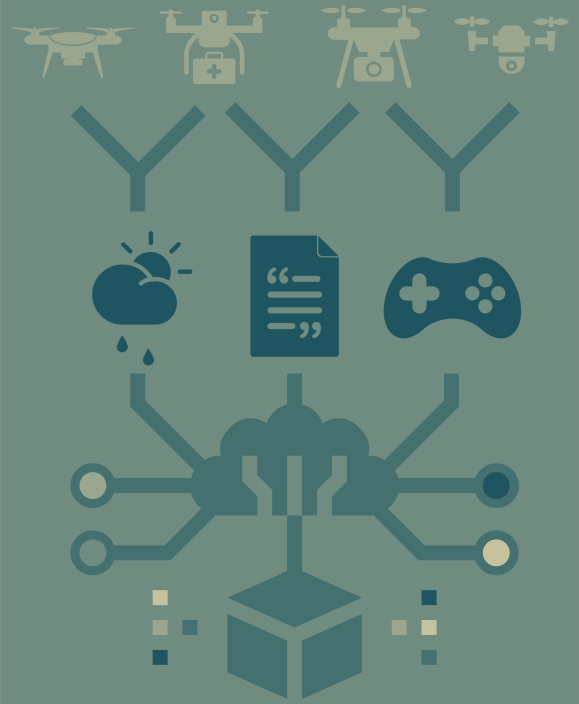
The next step is to look to the future. This is often the most difficult stage in decision-making. You need creativity, empathy and logic to make good predictions.
In some disciplines, you can get good insight into the future through simulations. Examples are randomized control trials or weather forecasting. By testing and analyzing variables a lot, you gain insight into long-term effects.
You can't create simulations for every discipline or personal decision. Fortunately, there are other methods you can use: games and stories. Games don't explore the future as accurately as simulations, but provide a safe environment to practice decision-making, test different strategies and come up with new ideas. Stories allow you to experience the future and see how you got there.
In all of these formats you need to explore multiple future scenarios. One pitfall is to lean too much on the scenario you think is most likely. A simple way to counter this is to always work out three options for the future: one where it gets better, one where it gets worse and one where something crazy happens.
Prime Minister Marsh could have outlined three options for how the debate might go:
The first two steps help you to look at the subject from new angles. It does not offer you certainty about what will actually happen, but it does prepare you for a range of possible options. Based on this, you can make an informed decision.
In some cases, this is easy. With the help of System 2, you have already done all the work in exploring perspectives and scenarios, and from this analysis the right choice becomes obvious quickly. This is because your brain, in this case System 1, is excellent at thinking through complicated decisions when it comes to imagining the effects on you and other people. With this, the final decision is sometimes more art than science.
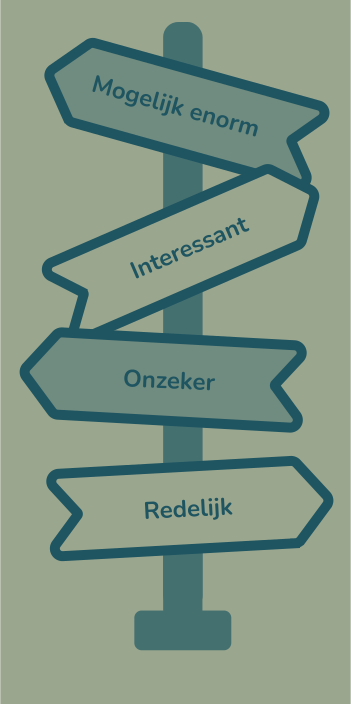
If a decision isn’t easily made, you have to make trade-offs. You can choose the option with the greatest chance of success. Also, you can go for the direction where the risk of disastrous impact is lowest. Or, for example, the option that allows you to still make adjustments while you're at it, so you can anticipate new events.
Prime Minister Marsh obviously does not have full control over how the debate unfolds, but she can make a choice in how she acts. She could have chosen the following options:
Steven Johnson describes in 'Farsighted' how the raid on Osama Bin Laden followed an extensive process of mapping, predicting and deciding. In the video below you see how President Obama and Admiral McRaven look back on this process and emphasize how important the human aspect of such a decision is.
Well, I'll never make a wrong decision again. I put in some effort to read this chapter, actively clicked on the examples and even watched the whole(!) video. Hello important life matters, I'm ready for you. Maybe also just change my LinkedIn name to Premium Executive Master of Smart Long Term Decisions ©, sounds appropriate now.
Maybe this is a little too premature still, but I appreciate the enthusiasm. This is all theory; applying it in daily life is usually a bit trickier. Making good decisions requires practice. Experts make good estimates because they can apply the right methods with optimal cooperation between System 1 and 2.
In the next chapter you will learn about practical methods that go with each step. Think of an important situation in your daily life and apply it.